

Visual Testing (VT)
The first and most important inspection method.
The Foundation of Every Inspection Programme
Visual Testing is the most fundamental and widely used non-destructive testing method. Every inspection programme — regardless of sector, material, or component — begins with a visual assessment. It is the first line of defence against surface defects, fabrication errors, and in-service degradation, and most codes require it before any supplementary testing is carried out.
VT catches the obvious defects that more expensive NDT methods should not have to find. Cracks, misalignment, weld profile issues, and corrosion that are visible to a trained inspector can be identified and addressed before committing to ultrasonic, radiographic, or other supplementary testing. Skipping VT or performing it inadequately means defects pass through to later inspection stages — or worse, into service — where the cost of correction multiplies.
VT involves the systematic examination of components using the naked eye, magnifying tools, borescopes, videoscopes, and cameras. Inspectors assess surface condition, weld profile, joint alignment, and overall workmanship against applicable codes and specifications. Clearscope's qualified inspectors integrate visual testing into broader inspection programmes — combining VT with other NDT methods where required to provide complete coverage.
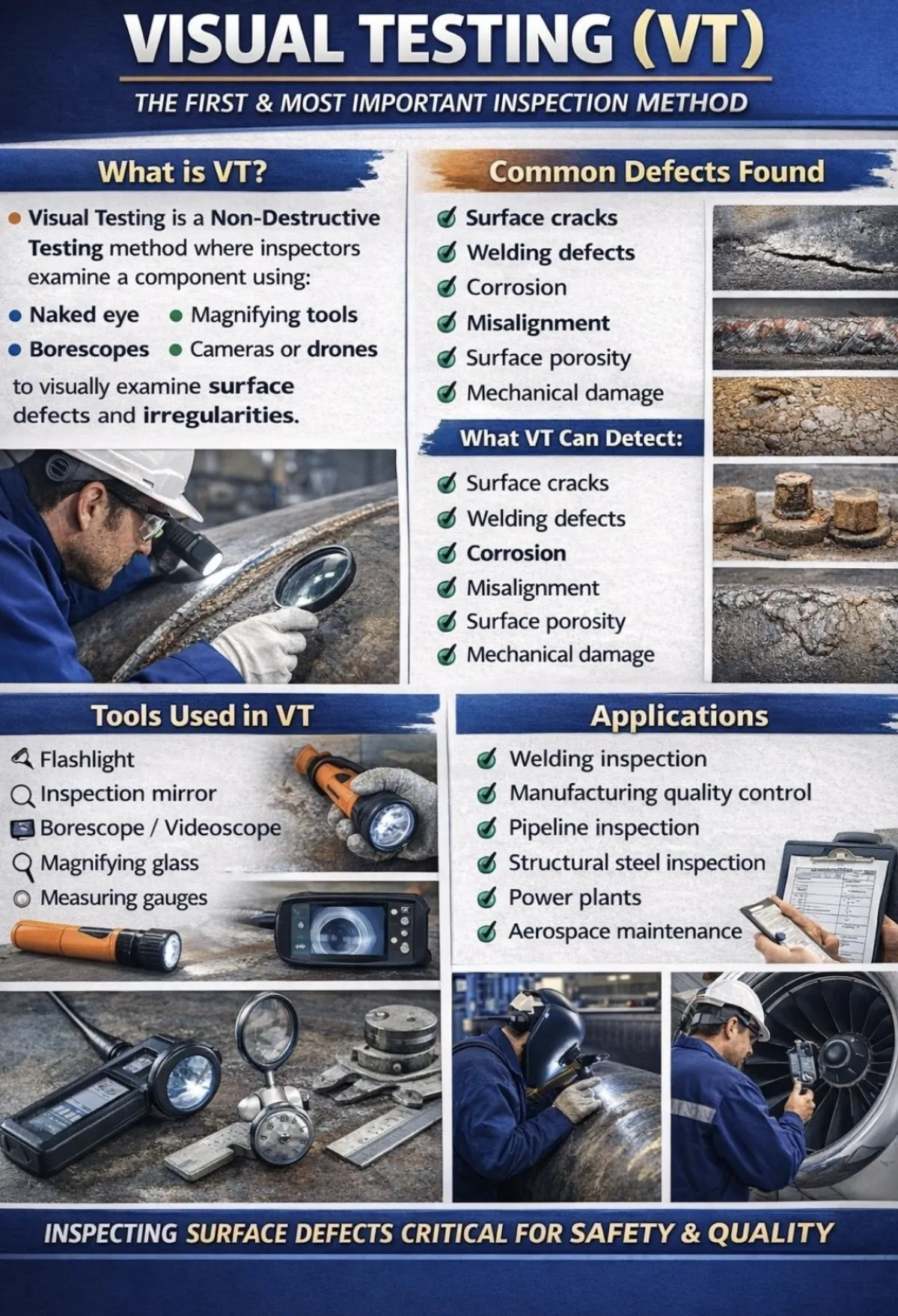
What VT Detects
Visual testing identifies surface-breaking defects and irregularities that affect structural integrity, coating adhesion, and code compliance.
Tools & Equipment
Standard VT equipment used by our inspectors for direct and remote visual examination.
Applications
Visual testing is applied across every sector where surface quality, weld integrity, and structural condition matter.
Welding inspection
Pre-weld fit-up checks and post-weld visual assessment of joint quality, profile, and surface finish to applicable codes.
Manufacturing QC
In-process and final inspection of fabricated components, castings, and machined parts for surface defects and dimensional conformance.
Pipeline inspection
External and internal visual assessment of pipeline welds, coatings, and structural condition during construction and in-service.
Structural steel
Inspection of connections, welds, and surface condition on buildings, bridges, and infrastructure steelwork to EN 1090 requirements.
Power plants
Routine and outage inspection of pressure parts, boiler tubes, turbine components, and structural supports.
Aerospace maintenance
Visual checks of airframe structures, engine components, and landing gear as part of scheduled maintenance programmes.
How Clearscope Helps
What we deliver — specific, practical, and built to hold up under audit.
Qualified VT Inspectors
All visual inspections carried out by qualified personnel certified to the required standard — not general labourers with a torch.
Structured Inspection to Code
VT performed systematically to the applicable standard — ISO 17637 for welds, EN 1090 for structural steelwork, or your project specification.
Reporting
Full inspection reports with photographic evidence, defect location, acceptance determination, and recommendations for supplementary NDT where required.
NDT Programme Integration
VT coordinated with supplementary methods — DPT, MPI, UT, RT — to provide complete inspection coverage across your project.
Need visual testing?
Surface defect detection critical for safety and quality. Talk to us about your inspection requirements.