

Dye Penetrant Testing (DPT)
Reliable surface defect detection through capillary action.
What Is Dye Penetrant Testing?
Dye Penetrant Testing (DPT), also known as Liquid Penetrant Testing (LPT or PT), is one of the most widely used non-destructive testing methods for detecting surface-breaking defects. If you are a fabricator or manufacturer working with aluminium, stainless steel, plastics, ceramics, or any non-ferromagnetic material, DPT is your primary surface inspection method — because magnetic particle testing simply will not work on these materials.
Surface-breaking defects that go undetected do not stay static. Under cyclic loading, thermal stress, or vibration, they propagate — growing until the component fails. A hairline crack missed during fabrication becomes a through-wall defect in service. DPT catches these defects early, before they reach the point of failure.
DPT works on a simple principle: a coloured or fluorescent penetrant is applied to the test surface, drawn into any open discontinuities by capillary action, then made visible using a developer. It is commonly applied to welds, castings, forgings, and machined components across manufacturing, construction, and energy sectors. Clearscope's PCN-certified technicians carry out penetrant testing to ISO 3452, with full reporting and traceability for every inspection.
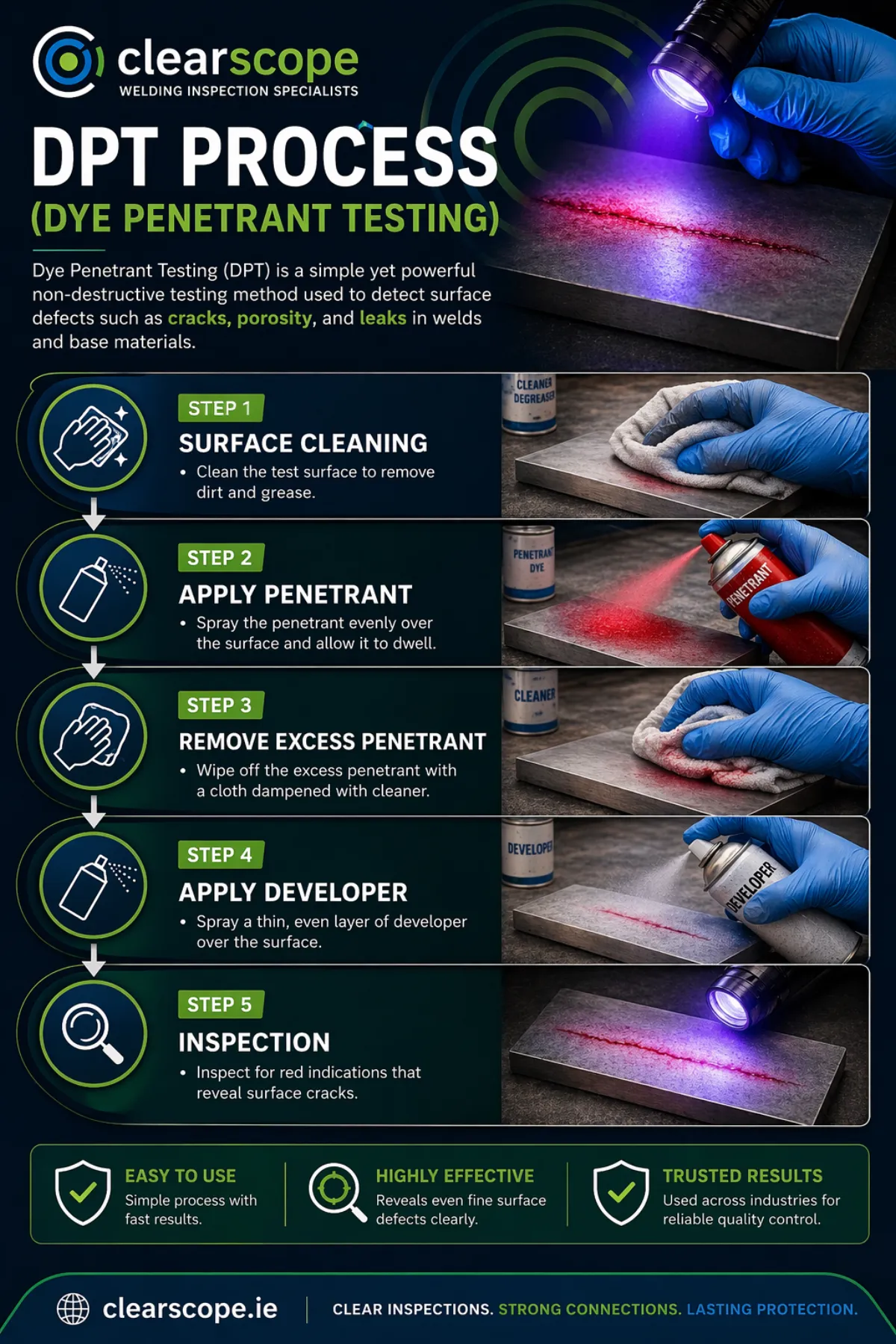
The 5-Step Process
A straightforward sequence that delivers reliable, repeatable results.
Surface Cleaning
Clean the test surface to remove dirt, grease, paint, and other contaminants that could mask defects or produce false indications.
Apply Penetrant
Spray the penetrant evenly over the surface and allow it to dwell. Dwell time depends on the material, temperature, and expected defect type.
Remove Excess Penetrant
Wipe off the excess penetrant with a cloth dampened with cleaner, leaving only the penetrant trapped in surface-breaking defects.
Apply Developer
Spray a thin, even layer of developer over the surface. The developer draws trapped penetrant back out through capillary action.
Inspection
Inspect for red indications that reveal surface cracks, porosity, or other surface-breaking discontinuities.
Defects Detected
Why DPT?
Easy to Use
Simple process with reliable results. Minimal equipment required.
Highly Effective
Reveals surface defects missed by visual inspection alone, including fine cracks and porosity.
Trusted Results
Used across industries for reliable quality assurance. Accepted by all major certification bodies.
Applicable Standards
ISO 3452 — the international standard governing penetrant testing procedures, equipment, and acceptance criteria. All Clearscope DPT inspections are carried out in accordance with this standard.
Limitations
Detects only surface-breaking defects — not internal or subsurface discontinuities. For internal flaw detection, ultrasonic testing or radiographic testing should be specified.
How Clearscope Helps
What we deliver — specific, practical, and built to hold up under audit.
On-Site & Workshop DPT
Portable DPT kits deployed to your fabrication shop, construction site, or maintenance facility — no need to transport components.
Fluorescent & Visible Dye Methods
We select the right penetrant system for your application — visible dye for standard inspections, fluorescent for maximum sensitivity on critical components.
Reporting to ISO 3452
Full inspection reports documented to ISO 3452 with defect location, indication type, acceptance determination, and photographic evidence.
PCN-Certified Technicians
All DPT inspections carried out by PCN-certified technicians qualified to the required level for your application.
Need dye penetrant testing?
Talk to our PCN-certified technicians about your surface inspection requirements.