

Bolt Failure Analysis
Understanding how bolts fail — and how to prevent it.
Why Bolt Failure Analysis Matters
Bolts may be small, but they are vital for the safety, reliability, and performance of machines and structures. If you are an engineer, maintenance team lead, or asset owner who has experienced a fastener failure — or wants to prevent one — bolt failure analysis tells you exactly what went wrong and how to stop it happening again.
A single bolt failure can cause structural collapse, equipment damage, pressure system leaks, or safety incidents. The consequences extend beyond the immediate failure: production downtime, insurance claims, regulatory investigation, and in the worst cases, injury. Most bolt failures are preventable — but only if the root cause is properly identified and addressed.
Bolt failure analysis examines the root cause of fastener failures across tensile overload, fatigue, corrosion, and thread stripping. By identifying the failure mode, Clearscope helps engineering teams select the right bolt grade, specify correct torque values, and design maintenance programmes that catch problems before they become incidents. This service supports manufacturers, fabricators, and construction firms working to standards including EN 1090, ASME, and ISO 898.
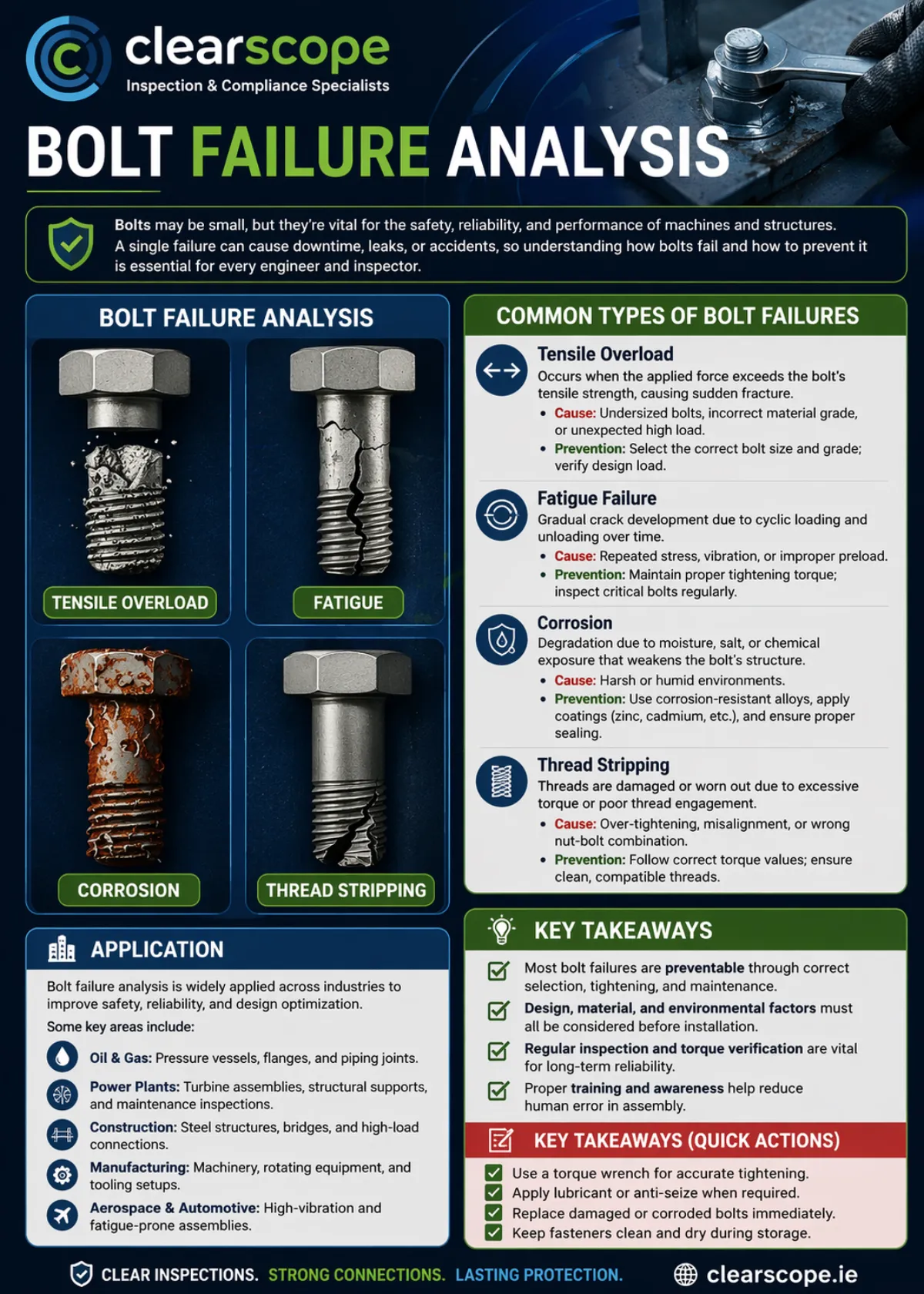
Common Types of Bolt Failures
Tensile Overload
Occurs when the applied force exceeds the bolt's tensile strength, causing sudden fracture.
Cause
Undersized bolts, incorrect material grade, or unexpected high load.
Prevention
Select the correct bolt size and grade; verify design load.
Fatigue Failure
Gradual crack development due to cyclic loading and vibrations over time.
Cause
Repeated stress, vibration, or improper preload.
Prevention
Maintain proper tightening torque; inspect critical bolts regularly.
Corrosion
Degradation due to moisture, salt, or chemical exposure that weakens the bolt's structure.
Cause
Harsh or humid environments.
Prevention
Use corrosion-resistant alloys, apply coatings (zinc, cadmium, etc.), and ensure proper drainage.
Thread Stripping
Thread/bolt damage or worn out due to excessive force or poor thread engagement.
Cause
Over-tightening, misalignment, or wrong nut-bolt combination.
Prevention
Follow correct torque values; ensure compatible thread/grade.
Key Takeaways
Most bolt failures are preventable through correct selection, tightening, and maintenance.
Environmental, thermal, and mechanical factors must all be considered before installation.
Regular inspection and torque verification are vital for long-term safety.
Proper training and awareness help reduce human error in operations.
Industries
Bolt failure analysis is widely applied across industries to improve safety, reliability, and design optimisation.
Pressure vessels, flanges, and piping joints.
Turbine assemblies, structural supports, and reactor components.
Steel structures, bridges, and high-load connections.
Machinery, rotating equipment, and fastened assemblies.
High vibration and fatigue-prone assemblies.
Quick Actions
- 1 Use a torque wrench for accurate tightening.
- 2 Apply lubricant or anti-seize when required.
- 3 Replace damaged or corroded bolts immediately.
- 4 Keep fasteners clean and dry during storage.
How Clearscope Helps
What we deliver — specific, practical, and built to hold up under audit.
Failure Mode Investigation
We examine the failed fastener to determine the failure mode — tensile overload, fatigue, corrosion, or thread stripping — and document the findings.
Root Cause Analysis
Structured root cause analysis using metallurgical evidence, load calculations, and environmental assessment to identify why the bolt failed.
Torque Verification
On-site torque audits of bolted connections to verify correct preload and identify undertightened or overtightened fasteners.
Material Testing
Hardness testing, chemical analysis, and mechanical testing to confirm bolt grade and identify material-related failure causes.
Prevention Recommendations
Practical recommendations for bolt selection, installation procedures, and maintenance programmes to prevent recurrence.
Need fastener inspection?
Talk to us about bolt failure analysis, torque verification, and fastener compliance for your operations.