
Process Control
Consistent checks. Stronger processes. Safer people. Better outcomes.
Structured Process Verification That Delivers Consistent Quality
The 6M Checklist is a structured approach to process control used across manufacturing and construction. It examines six categories — Man, Machine, Material, Method, Measurement, and Mother Nature — to verify that every element of a process is controlled, documented, and capable of producing conforming output. If you are a production manager, quality engineer, or operations lead in a manufacturing or fabrication environment, this is the framework that turns process variability into predictable output.
Inconsistent processes produce inconsistent quality. When a weld fails, a dimension drifts, or a non-conformance appears during audit, the root cause almost always traces back to one of these six areas — and the consequences cascade: NCRs pile up, audit findings multiply, client complaints increase, and your team spends more time firefighting than producing. The 6M Checklist gives your teams a repeatable framework for identifying and addressing those risks before they become defects, delays, or audit findings.
Clearscope applies the 6M framework as part of our process control and quality management support. Whether you are implementing factory production control, building out an ISO system, or simply trying to reduce variability on the shop floor, this checklist gives you the structure to control what matters.
The 6M Checklist
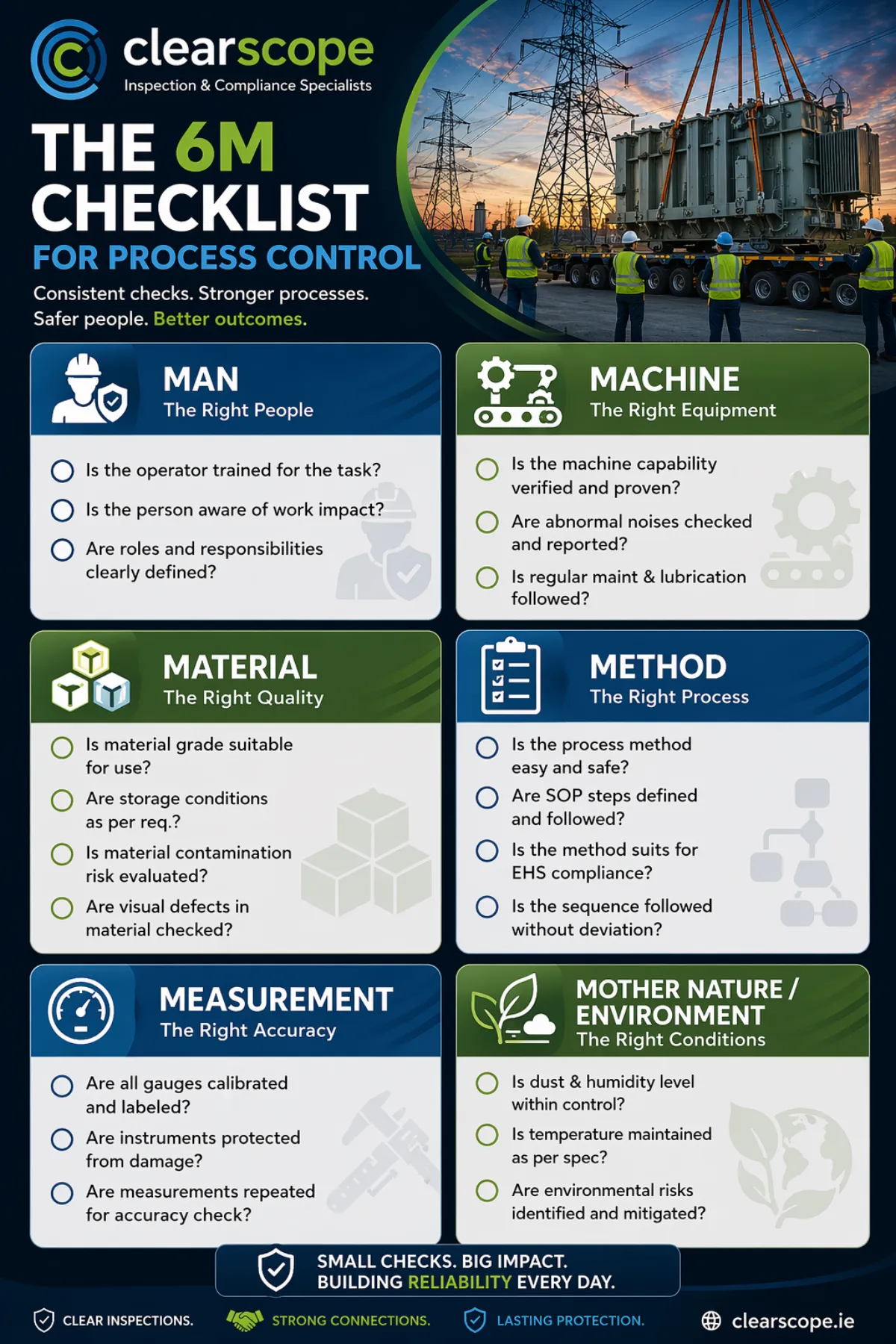
Six categories. One systematic approach to process verification. Each M addresses a critical input that affects product quality, safety, and compliance.
Man / Woman
The Right People- Is the operator trained for the task?
- Is the person aware of work impact?
- Are roles and responsibilities clearly defined?
Machine
The Right Equipment- Is the machine capability verified and proven?
- Are abnormal noises checked and reported?
- Is regular maintenance and lubrication followed?
Material
The Right Quality- Is material grade suitable for use?
- Are storage conditions as per requirements?
- Is material contamination risk evaluated?
- Are visual defects in material checked?
Method
The Right Process- Is the process method easy and safe?
- Are SOP steps defined and followed?
- Is the method suitable for EHS compliance?
- Is the sequence followed without deviation?
Measurement
The Right Accuracy- Are all gauges calibrated and labelled?
- Are instruments protected from damage?
- Are measurements repeated for accuracy check?
Mother Nature / Environment
The Right Conditions- Is dust and humidity level within control?
- Is temperature maintained as per spec?
- Are environmental risks identified and mitigated?
Why Process Control Matters
Process control is not about bureaucracy — it is about reducing variability. Every time a process runs differently, the output varies. In manufacturing and construction, that variation translates directly to rework, waste, non-conformance reports, and failed inspections. The cost of correcting defects after the fact is always higher than the cost of controlling the process upfront.
Beyond quality, effective process control supports EHS compliance by ensuring that people are trained, equipment is maintained, and environmental conditions are monitored. For organisations pursuing or maintaining sector-specific certifications, demonstrable process control is not optional — it is a core audit requirement. Certification bodies expect to see evidence that processes are defined, controlled, monitored, and improved.
Key Principles
How Clearscope Helps
What we deliver — specific, practical, and built to hold up under audit.
6M Implementation
We implement the 6M framework in your facility — customised checklists for each process, covering Man, Machine, Material, Method, Measurement, and Environment.
Process Auditing
Systematic review of your production processes against the 6M criteria, identifying gaps and non-conformances before they reach final inspection.
Checklist Development
Custom process control checklists designed for your specific operations — practical, shop-floor-ready, and aligned to your QMS requirements.
Training
Training for operators, supervisors, and quality teams on 6M principles, process verification techniques, and EHS compliance integration.
EHS Compliance Integration
Process control that addresses environmental, health, and safety requirements alongside quality — one framework, not three separate systems.
Need process control support?
Small checks, big impact. Building reliability every day. Talk to us about implementing structured process control in your organisation.